The best Testmo alternatives for 2026
Nine tools worth evaluating when you leave Testmo, ours included, ranked on manual and automated testing in one place, a way in for a Testmo export, the price for a small team and where each can run.
How we picked
Testmo keeps manual test cases, exploratory sessions and automated results in one lightweight tool, and prices by plan instead of by seat: Team is $59 a month with 5 users, Business $249 with 15 and Enterprise $599 with 25, with a 21-day trial and no free plan. On January 23, 2025 it joined Sembi, the company Idera launched that day to hold TestRail, Xray, Testmo, Ranorex, Kiuwan and PreEmptive. Testmo's announcement called it business as usual, with Testmo operating as its own team.
Teams look elsewhere for reasons the vendor's own pages make plain. Testmo, TestRail and Xray now share an owner, which matters to a buyer who chose Testmo as the independent option. It runs only in the cloud, with no on-premises edition. And its plans step up in blocks: ten users on Team cost $99 a month, and the next step is Business.
We ranked the nine tools below on four things a team leaving Testmo needs, in this order: manual cases and automated results in one tool, as Testmo has them; a way in for a Testmo export; the price for a team of five to fifteen; and where it can run. Testmo exports to CSV, Excel and JSON on every plan and a whole instance to JSON once a day, without attachment files, and its own documentation says the export can be used to migrate to another tool. Of the tools ranked here, only Testiny says it supports a move from Testmo. Every other route is a CSV or spreadsheet import, so check that steps, folders and results arrive as you expect before you commit.
TestRail links to a full comparison with Stride; the other picks carry their write-ups here. Two disclosures: TestRail belongs to Sembi, like Testmo, and Stride, our own product, is on the list too, where these criteria rank it last; its entry says why. Every price was read on the vendor's own site on November 20, 2026.
At a glance
Disclosure: Stride is our product. We rank it by the same criteria as every other tool on this list, and its entry says where it falls short.
| Rank | Tool | Best for |
|---|---|---|
| 1 | Testiny | The closest like-for-like, and the one ranked tool that says it supports a move from Testmo, with a free plan and a self-hosted edition that Testmo lacks.The closest like-for-like |
| 2 | Qase | A free plan for the smallest teams and importers for more than a dozen tools, though Testmo is not among them and an import brings test cases only.The smallest teams, on a free plan |
| 3 | BrowserStack Test Management | A free plan with no cap on test cases or runs, one-step importers for five other test managers, and JUnit XML or BDD JSON reports from CI.A free plan with no cap on cases |
| 4 | Tuskr | The lowest per-user price here: a free plan for 5 users, and a Team plan at $90 per user a year.The lowest per-user price |
| 5 | TestRail | The established standalone test manager, with on-premises hosting and AI on every plan. A Sembi product, like Testmo, so not a change of owner.An established standalone tool |
| 6 | TestCollab | AI test case generation and an automation copilot on its Elite plan, a two-way Jira plugin, and hosting in your own AWS account on Enterprise.AI test generation and Jira sync |
| 7 | PractiTest | Requirements, tests, runs and issues in one hierarchy, with the SmartFox AI assistant on both plans, for teams that want management reporting.Management reporting |
| 8 | Kiwi TCMS | The open-source route: free to run yourself, or a hosted private tenant at a flat $150 a month with unlimited users.An open-source route |
| 9 | Stride(our product) | The narrowest fit here: for teams that want test cases linked to the acceptance criteria and stories they verify, in the tool that also holds the backlog.Tests linked to stories and the backlog |
Quick answers
What are the best Testmo alternatives?
Testiny is the closest like-for-like and says it supports a move from Testmo. Qase and BrowserStack Test Management have free plans, Tuskr has the lowest per-user price, and TestRail adds on-premises hosting but shares Testmo's owner, Sembi. TestCollab and PractiTest suit teams that want AI drafting or management reporting, Kiwi TCMS is open source, and Stride, our own product, links tests to the stories they verify.
Who owns Testmo?
Sembi. Testmo announced on January 23, 2025 that it had joined Sembi, the company Idera launched that day to hold TestRail, Xray, Testmo, Ranorex, Kiuwan and PreEmptive. Testmo said it would keep operating as its own team, and its legal entity is still Testmo GmbH.
Testmo vs Qase: which is better?
Testmo is cheaper for a small paying team: $59 a month covers 5 users, where Qase Teams is $35 per user a month billed yearly, from 5 users. Qase has a free plan for up to 4 users, which Testmo lacks, and includes 2,000 AI credits a month on Teams. Testmo includes its AI on every plan, with test case generation still in beta.
Pricing, side by side
| Tool | Paid plans (annual / monthly) | How AI is priced |
|---|---|---|
| Testiny | Starter $15.42 / $18.50 · Business $17.08 / $20.50, from 5 users · Enterprise $25 / $30, in packs of 5 | No AI test generation is listed on its pricing page; an MCP server for AI tools comes with Starter and above. |
| Qase | Teams $35 / $42, from 5 users · Enterprise on quote | Teams includes 2,000 AI credits a month and Enterprise 4,000; extra credits are $0.40 each. Free includes none. |
| BrowserStack Test Management | Team $99 / $149 a month for 5 users · Team Pro $199 / $249 · Team Ultimate and Enterprise on quote | Its AI agents, such as the test case generator, are listed under Team Ultimate. |
| Tuskr | Team $7.50 / $9 · Business $12.50 / $15 · Enterprise $24.17 / $29, from 5 users | Its pricing page states no AI price or allowance. |
| TestRail | Essentials $22 / $25, up to 5 users · Professional $39 / $41 · Enterprise $78, annual only | AI test case, BDD scenario and script generation and an MCP server are included in every plan. |
| TestCollab | Premium $29 / $35 · Elite $39 / $45 for a small team, less per user as it grows · Enterprise on quote | AI test case generation and QA Copilot come with Elite; no separate AI charge is shown. |
| PractiTest | Team $49 per user at 5 licences, $47 at 10, billed yearly; $54 monthly for up to 5 · Corporate on quote | No AI price or credits are published. The SmartFox AI assistant is on both plans; AI Test Value Score and the MCP integration are Corporate only. |
| Kiwi TCMS | Free to self-host · Self Support $35 · Private Tenant $150 · Enterprise $600 a month, each a flat price | No AI feature is priced; a Model Context Protocol server is listed under Enterprise. |
| Stride(our product) | Starter $12 / $15 · Pro $32 / $39 · Enterprise from $69 | AI credits are included in every seat (200, 1,000 or 1,500 a month by plan), with top-ups; when they run out, AI pauses rather than billing overage. No free plan. 14-day free trial. |
Per user a month in US dollars, before tax, shown as billed annually / billed monthly where a vendor shows both; BrowserStack and Kiwi TCMS price per team, not per user. Read on each vendor's own pricing page on 2026-11-20. Free plans are left out; the FAQ lists them.
The ranking
- 1
Testiny
The closest like-for-like, and the one ranked tool that says it supports a move from Testmo, with a free plan and a self-hosted edition that Testmo lacks.
Testiny is a lightweight test manager in Testmo's mould, from Mategra GmbH. Its own Testmo comparison says it provides migration support and a REST API for the move, though its documented migration guides name TestRail, Xray, Zephyr, Qase, qTest, TestLink and CSV or Excel, not Testmo. The Free plan covers up to 3 users and 1,000 cases, plans, runs and executions in total; Starter is $18.50 per user a month, or $15.42 billed yearly, for up to 25 users, and Business $20.50, or $17.08, from 5 users, with a two-way Jira integration on every plan and an MCP server from Starter. Testiny Server, to host yourself, starts at $300 per user a year in packs of five. Best fit: small teams that want Testmo's simplicity from another vendor. The trade-offs: automation features start at Business, and for five or ten users it costs more than Testmo's bundled plans.
From Mategra · Free for up to 3 users · Starter $15.42 and Business $17.08 per user a month billed yearly, $18.50 and $20.50 monthly · Server edition to self-host
- 2
Qase
A free plan for the smallest teams and importers for more than a dozen tools, though Testmo is not among them and an import brings test cases only.
Qase is a standalone test manager with a free plan for up to 4 users and 2 projects, keeping 30 days of test history and including a basic MCP server. Teams is $35 per user a month billed yearly, or $42 monthly, from 5 users, with 2,000 AI credits a month. Qase documents imports from more than a dozen tools, among them TestRail, Xray, Zephyr, TestLink, qTest, PractiTest and Azure DevOps, but not Testmo, and says an import brings test cases only, so runs and results stay behind. Best fit: teams of up to four that can live on the free plan, or larger teams that want AI credits included. The trade-off: at five users Teams costs $175 a month against Testmo's $59.
Free for up to 4 users and 2 projects · Teams $35 per user a month billed annually, $42 monthly, from 5 users · Enterprise on quote
- 3
BrowserStack Test Management
A free plan with no cap on test cases or runs, one-step importers for five other test managers, and JUnit XML or BDD JSON reports from CI.
BrowserStack Test Management has a free plan with unlimited test cases and test runs, import by CSV or API, and a Jira app. Team is $99 a month for 5 users billed annually, or $149 month to month, and Team Pro $199 or $249; Team Ultimate and Enterprise are quoted. It imports test cases with their attachments from TestRail, Zephyr Scale, Zephyr Squad, Xray and qTest in one step, plus TestLink and CSV, and takes automated results as JUnit XML or BDD JSON reports. Best fit: teams that already use BrowserStack for browser and device testing. The trade-offs: Testmo is not among its importers, its AI agents are listed only under Team Ultimate, and its Team plan costs more than Testmo's.
Free plan with unlimited test cases and runs · Team $99 a month for 5 users billed annually, $149 monthly · Team Pro $199 · higher plans on quote
- 4
Tuskr
The lowest per-user price here: a free plan for 5 users, and a Team plan at $90 per user a year.
Tuskr is a cloud test manager with a free plan for up to 5 users, 5 projects and 1,000 test cases. Paid plans start at 5 users: Team is $90 per user a year, about $7.50 a month, or $9 billed monthly; Business is $150 a year and Enterprise $290. That puts five users on Team at $37.50 a month, below Testmo's $59. It imports JUnit XML results with attachments through a command-line tool, can raise a Jira issue when a test fails, and offers a 15-day trial. Best fit: small teams for whom price is the reason to leave. The trade-off: we found no documented Testmo importer on its site, so plan the move as a manual import.
Free for up to 5 users · Team $90, Business $150 and Enterprise $290 per user a year, or $9, $15 and $29 a month · 5-user minimum on paid plans
- 5
TestRail
The established standalone test manager, with on-premises hosting and AI on every plan. A Sembi product, like Testmo, so not a change of owner.
TestRail is the standalone test manager most QA teams already know, with suites, runs, milestones and reports, and AI test case, BDD scenario and script generation plus an MCP server on every plan. Essentials is $22 per user a month billed annually for up to 5 users in the cloud, Professional $39 and Enterprise $78, and on-premises hosting comes with Professional or Enterprise, from 10 seats on a 12-month contract. It imports and exports by CSV and XML, and its command-line tool reads JUnit XML and Robot Framework results. Sembi owns TestRail, Xray and Testmo. Best fit: teams that need more reporting than Testmo has, or their own servers. The trade-offs: it comes from the same owner, there is no free plan, and five users on Essentials cost $110 a month against Testmo's $59.
A Sembi product · Essentials $22 (cloud, up to 5 users), Professional $39 and Enterprise $78 per user a month billed annually · 30-day trial
Stride vs TestRail
- 6
TestCollab
AI test case generation and an automation copilot on its Elite plan, a two-way Jira plugin, and hosting in your own AWS account on Enterprise.
TestCollab is a cloud test manager priced per user: for a small team Premium is $29 a month billed yearly, or $35 monthly, and Elite $39 or $45, with lower rates as the team grows and a 14-day trial. Elite adds AI test case generation and QA Copilot, its AI-powered test automation; Premium includes a two-way Jira plugin; and Enterprise can be hosted in your own AWS account. Test cases import from CSV or XLSX files. Best fit: teams that want AI drafting and a Jira link in one per-seat tool. The trade-offs: at five users Premium costs $145 a month against Testmo's $59, and we found no documented Testmo importer.
Premium $29 and Elite $39 per user a month billed yearly, $35 and $45 monthly, for a small team · Enterprise on quote · 14-day trial
- 7
PractiTest
Requirements, tests, runs and issues in one hierarchy, with the SmartFox AI assistant on both plans, for teams that want management reporting.
PractiTest keeps requirements, the test library, test sets and runs, and issues in one hierarchy, and its FireCracker tool uploads XML report files from CI or an automation framework. Team is sold in licence packs billed yearly: $49 per user a month at 5 licences and $47 at 10. Corporate is quoted, from 10 licences, and adds the MCP integration and Jira Data Center integration. The SmartFox AI assistant comes with both plans, and there is a 14-day trial. It imports CSV and XML, with migration pages for TestRail, qTest, Qase and OpenText ALM but none for Testmo. Best fit: QA organisations that report to management outside Jira. The trade-off: five licences cost $245 a month, about four times Testmo's Team plan.
Team $49 per user a month for a 5-licence pack, billed yearly ($47 at 10 licences) · Corporate on quote, 10-licence minimum · 14-day trial
- 8
Kiwi TCMS
The open-source route: free to run yourself, or a hosted private tenant at a flat $150 a month with unlimited users.
Kiwi TCMS calls itself the leading open source test management system, under GPL-2.0. You can run it yourself for free; the $35-a-month Self Support subscription comes with no technical support, a Private Tenant in its cloud is a flat $150 a month with unlimited users, and Enterprise, at $600 a month, runs on-premises inside your VPN and lists a Model Context Protocol server. Plugins report results from JUnit 5, junit.xml files, pytest, Robot Framework, TestNG and PHPUnit, and it integrates with Jira as a bug tracker. Best fit: teams that must host their own test data, or want a flat bill as headcount grows. The trade-offs: running it yourself takes more work than a hosted tool, and we found no documented importer for Testmo data.
Open source (GPL-2.0), free to self-host · Self Support $35 a month · Private Tenant $150 a month, unlimited users · Enterprise $600 a month
- 9
Stride
Our productThe narrowest fit here: for teams that want test cases linked to the acceptance criteria and stories they verify, in the tool that also holds the backlog.
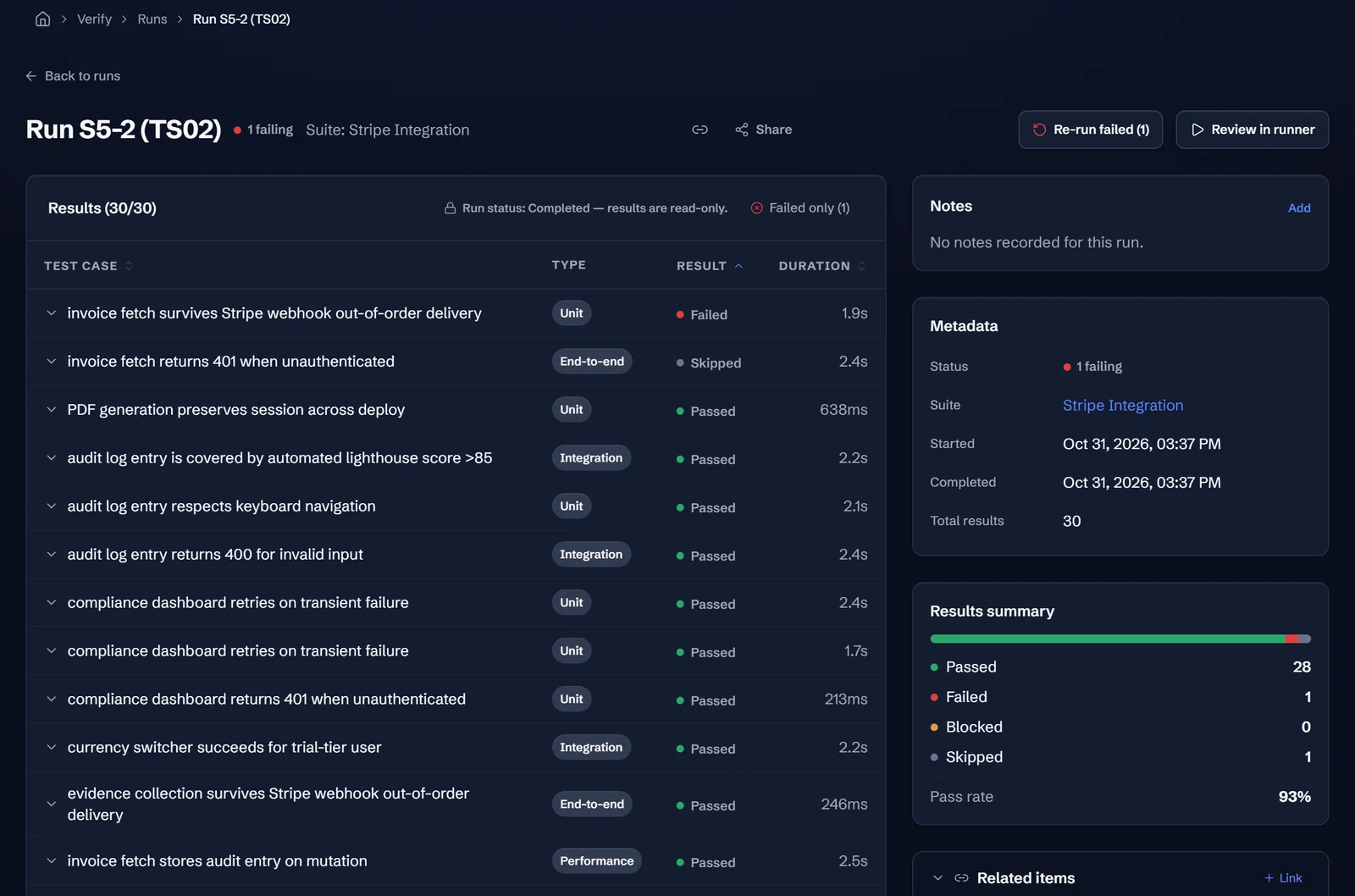
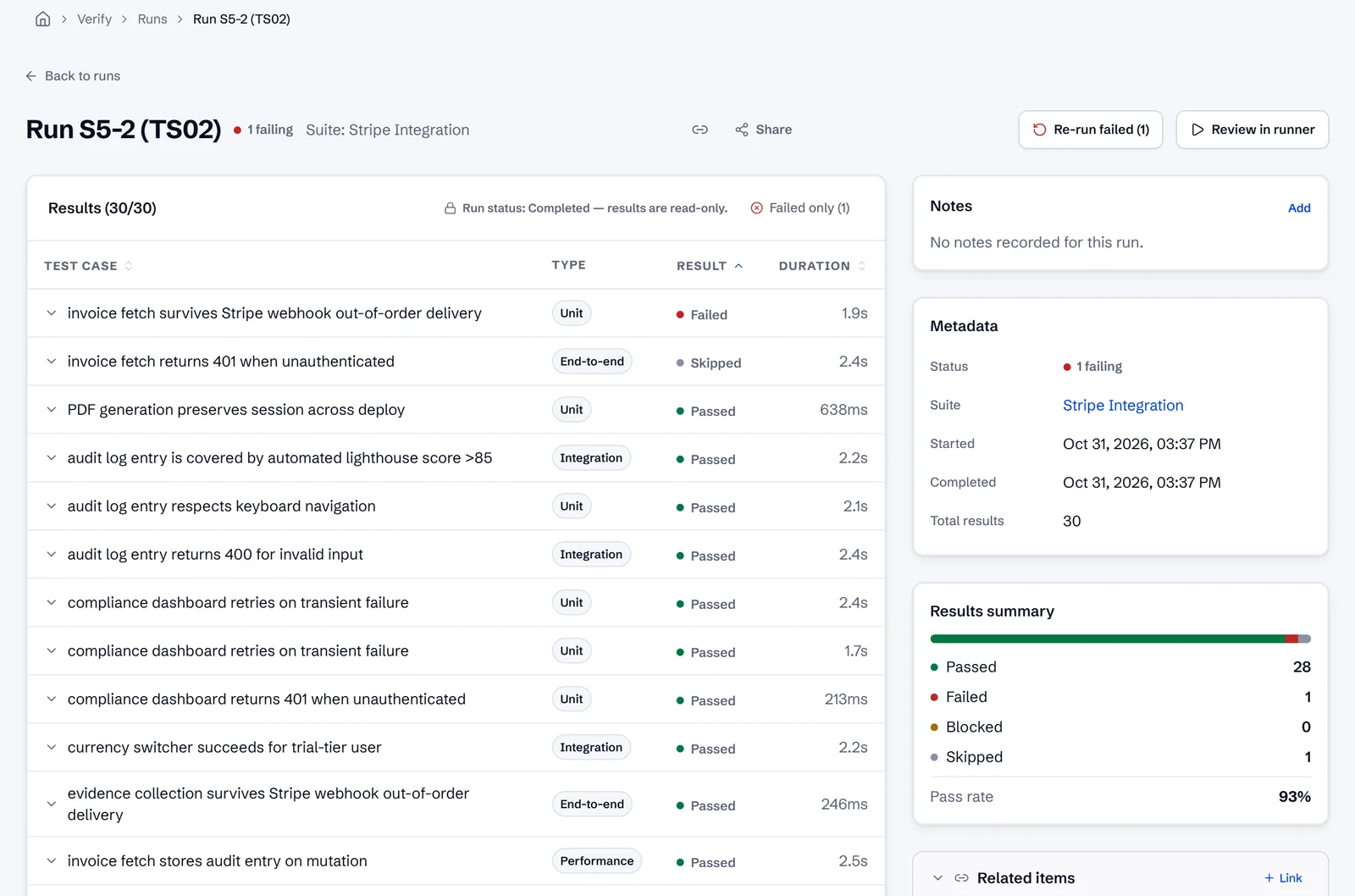
In Stride, a test case can link to the acceptance criterion it covers, AI drafts cases from those criteria with the link kept, results come from JUnit XML uploads, a coding agent over MCP or the API, and quality gates check pass rate, open critical defects and coverage before a release. It ranks last because these criteria weigh a like-for-like move from Testmo: Stride replaces the tracker as well as the test manager, has no importer for a Testmo export (a JUnit XML upload creates cases from test names, but steps, folders and past runs must be rebuilt), and has no free plan. Its test management is also shallower than a dedicated tool's, with fewer report types. The trade-off in its favour: tests, stories and defects share one graph and one bill, priced from $12 a seat a month, billed yearly.
Our product · Starter $15, Pro $39, Enterprise from $69 per seat a month · No free plan · 14-day free trial
AI test generation in Stride
Honourable mentions
- ZephyrSmartBear's test management app for Jira, at $10 a month for up to 10 Jira users and $7.42 per user from 11 to 100; it lives inside Jira, and its licence covers every user on the Jira site, not only the testers.
- XrayXblend's test management app for Jira, at $10 a month for up to 10 Jira users and $7.28 per user from 11 to 100; a Sembi product, like Testmo and TestRail.
- Allure TestOpsFrom Qameta Software, at $39 per user a month in the cloud or on-premises, available from one user, with volume pricing for larger teams.
- TestMonitorOwned by Cerios since September 2024; Starter is $11 per user a month billed yearly, with 3 users included, and Professional starts at 5 users, with a JUnit XML importer and a 14-day trial.
- QA TouchHas a free plan for 3 projects and 100 test cases and paid plans from $5 per user a month; its own blog lists Testmo among the tools it can import test cases from.
Where Stride fits
Stride is our product, and it ranks last in the list below, labelled as ours. It fits the team that is replacing its tracker as well as its test manager: in Stride, test cases, runs and defects sit in the same graph as the stories they verify, and a case can link to the acceptance criterion it covers. A team that only wants a different test manager should choose from the top of the list.
For how Stride drafts test cases from acceptance criteria and keeps each one linked, see AI test generation in Stride.
When to choose Stride
- You are replacing your issue tracker and your test manager together.
- You want each test case linked to the acceptance criterion it covers, with AI drafting cases from those criteria.
- Your results come from JUnit XML or from coding agents over MCP.
When Stride isn't the fit
- You only want a different test manager and are keeping your tracker.
- You need to carry Testmo runs, folders and history across.
- You need a free plan or an on-premises edition.
How Stride differs
| Competitor | How Stride differs |
|---|---|
| Testmo | Testmo is a dedicated test manager that integrates with the tracker you already use. Stride holds the stories and the tests in one graph, so it replaces both. |
| Testiny | Testiny is the closest swap for Testmo. Stride is the option for teams that want tests linked to acceptance criteria in the same tool as the backlog. |
FAQ
- How do I export my data from Testmo?
- Testmo exports to CSV, Excel and JSON on every plan, and a full-instance export writes test cases, results, sessions, projects and users to a JSON file, which can be scheduled once a day. Attachment files and uploads are not included, and the export cannot be restored into Testmo. Testmo's documentation says the files can be used to migrate cases, results and projects to another tool.
- Is there a free alternative to Testmo?
- Yes. BrowserStack Test Management's free plan has unlimited test cases and runs, Tuskr is free for up to 5 users, Qase for up to 4 and Testiny for up to 3, and Kiwi TCMS is open source and free to host yourself. Testmo itself has no free plan, only a 21-day trial.
- Can I self-host Testmo?
- No. Testmo says it is a cloud application and does not offer an on-premises server edition. Of the alternatives here, Kiwi TCMS and Testiny Server run on your own infrastructure, and TestRail offers on-premises hosting on its Professional and Enterprise plans, from 10 seats on a 12-month contract.
- How much does Testmo cost?
- Team is $59 a month with 5 users included, or $99 with 10. Business is $249 with 15 users and Enterprise $599 with 25, and both add users in blocks. Annual Business and Enterprise plans are 15% cheaper, and there is a 21-day trial. Read on Testmo's pricing page on November 20, 2026.
Related rankings
The best TestRail alternatives for 2026
Seven tools worth evaluating when you move off TestRail, ours included, ranked for teams whose tests increasingly run in CI, with the ownership fact most lists leave out.See picksThe best test management tools for 2026
Eight test-management tools worth evaluating in 2026, ours included, ranked by fit for modern engineering teams: from TestRail's enterprise depth to Qase's free plan.See picksThe best Xray alternatives for 2026
Nine tools worth evaluating when you leave Xray, ours included, ranked on where tests live, how much of Xray comes across, automation and BDD support, and price.See picksThe best qTest alternatives for 2026
Seven tools worth evaluating when you replace Tricentis qTest, ours included, ranked for enterprise and regulated teams that still need audit trails and traceability.See picks
See the product behind our own entry
The tour follows one story from the plan to a passed test, so you can judge where we placed Stride for yourself.